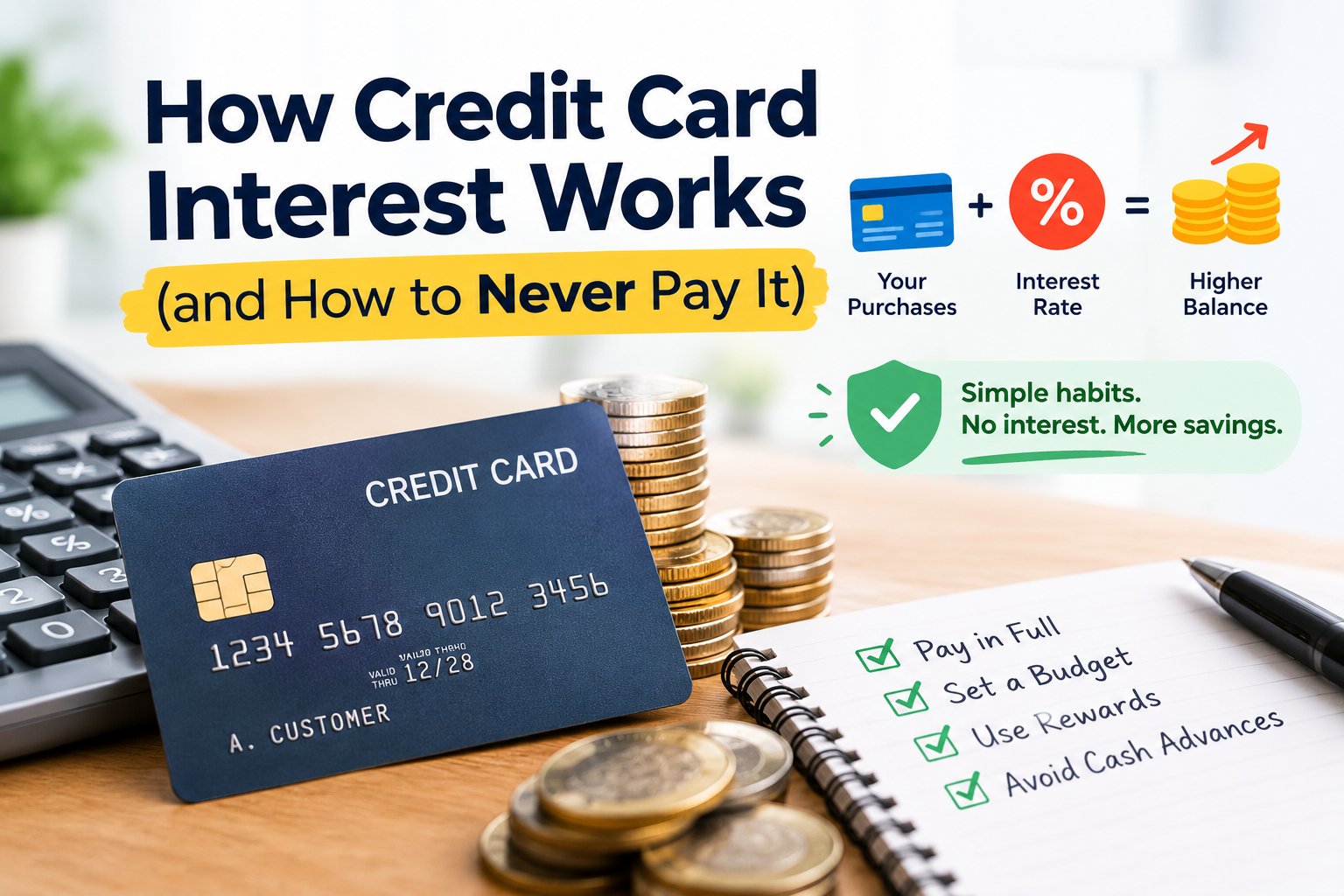
A credit card can be completely free to use, or one of the most expensive ways to borrow money. The difference comes down to one habit: whether you pay your full statement balance by the due date. This guide explains how credit card interest works, why the minimum payment is a trap, and how to avoid paying interest at all.
Our examples use ringgit (RM). Rates, rules and fees differ by country and by card, so always check your own card's terms.
- Most cards give you an interest-free period on purchases, but only if you pay the full statement balance by the due date.
- If you carry a balance, you usually lose that interest-free period, and new purchases start costing interest straight away.
- Paying only the minimum can stretch a debt over years and add thousands in interest.
- Cash advances usually charge interest from day one, plus a fee.
- A fixed monthly payment well above the minimum is the simplest way out of card debt.
The key terms, in plain language
| Term | What it means |
|---|---|
| Statement balance | What you owed at the end of the billing period |
| Due date | The last day to pay without a late fee |
| Grace period / interest-free days | The time between the statement and the due date when purchases don't cost interest, if you pay in full |
| Interest rate (APR) | The yearly rate charged on balances you don't clear |
| Minimum payment | The smallest amount you must pay to avoid a late fee. Often a small percentage of the balance or a fixed amount |
| Cash advance | Withdrawing cash with your card. Usually charged a fee and interest from the day you take it |
How the interest-free period works
The US Consumer Financial Protection Bureau (CFPB) describes the grace period as the time between the end of a billing cycle and the payment due date. If you pay your whole balance by then, you generally aren't charged interest on purchases.
Here's the catch. According to the CFPB, if you don't pay the full balance, you usually lose the grace period. You'll pay interest on the unpaid amount, and new purchases may start costing interest from the day you make them. Paying in full one month and not the next can cost you the grace period for more than one month.
"I paid most of it" isn't the same as "I paid it in full". On many cards, leaving even a small amount unpaid means interest on new purchases too. Check how your card works.
How interest is calculated
Card interest is usually quoted as a yearly rate but charged daily or monthly on your balance. A rough way to estimate one month's interest:
Balance × yearly rate ÷ 12
For example, a RM5,000 balance at 18% a year costs roughly RM75 in interest in one month (RM5,000 × 0.18 ÷ 12). That's RM75 spent on nothing, and next month interest is charged on the new, higher balance if you don't pay it down. That's compound interest working against you; see compound interest explained.
The minimum payment trap: a worked example
Here's an illustration, not a real card. You owe RM5,000 at 18% a year, and you stop using the card. Compare three ways to pay it off:
| How you pay | Time to clear (approx.) | Total paid (approx.) | Interest paid (approx.) |
|---|---|---|---|
| Minimum only (5% of the balance, at least RM50) | 69 months (almost 6 years) | RM6,880 | RM1,880 |
| Fixed RM300 a month | 20 months | RM5,800 | RM800 |
| Fixed RM500 a month | 11 months | RM5,460 | RM460 |
The minimum payment shrinks as your balance shrinks, so you pay less and less each month and the debt drags on for years. A fixed amount stays the same, so more of each payment goes to the actual debt. Moving from the minimum to RM300 a month saves about RM1,080 and clears the debt four years sooner.
Australia's Moneysmart makes the same point: if you can make higher repayments each month, you'll pay less interest and clear the debt faster. Its free credit card calculator (listed below) lets you try your own numbers.
How to pay no interest at all
- Only spend what's already in your budget. Use the card as a payment tool, not extra money.
- Set up automatic full payment of the statement balance from your bank account, if your bank allows it.
- Know your dates. Note the statement date and due date in your phone calendar.
- Never use it for cash. Cash advances usually cost a fee plus interest from day one.
- Check your statement every month for subscriptions you forgot. See hidden subscriptions and how to cancel them.
Already carrying a balance? A way out
- Stop adding to it. Put the card away and use debit for daily spending.
- List every card and loan with its balance, interest rate and minimum payment.
- Pick a fixed monthly payment you can keep, well above the minimum. Find the money with a zero-based budget.
- Pay extra on the highest-rate debt first, while paying minimums on the rest. This saves the most interest.
- Keep a small emergency fund so the next surprise doesn't go back on the card. See how to build an emergency fund.
- Ask for help early. If repayments feel unmanageable, talk to your bank or a free debt-advice service. In Malaysia, that's AKPK (Agensi Kaunseling dan Pengurusan Kredit).
Other card costs to watch
- Late payment fees if you miss the minimum.
- Annual fees, sometimes waived if you spend a minimum amount. Check whether the waiver is worth chasing.
- Foreign currency fees on overseas or online purchases in another currency.
- Instalment plans offered by the card, which may have their own fees or interest.
Frequently asked questions
Does paying the minimum hurt my credit record?
Paying at least the minimum on time keeps your account in good standing. But a high balance carried for a long time is expensive and can affect how lenders see you.
Are rewards and cashback worth it?
Only if you pay in full every month. One month of interest on a large balance can wipe out a year of cashback.
Is a balance transfer a good idea?
It can lower your interest for a while, but check the transfer fee and the rate when the offer ends, and have a plan to clear the balance before then.
Is buy now pay later better than a credit card?
It's different, not automatically better. See buy now pay later: what to know before you click.
The bottom line
A credit card costs nothing if you pay the full statement balance every month. Carry a balance, and you lose the interest-free period and start paying interest on interest. If you're already in debt, stop using the card, choose a fixed payment well above the minimum, and clear the highest-rate balance first.
How we wrote this: this guide draws on the US Consumer Financial Protection Bureau and Moneysmart (Australian Government), listed below. The numbers in the example are calculated illustrations, not a real card. This is general information, not personal financial advice.